Everything you need to rank on Google.
Nothing you'd have to take down.
Writelio researches the gap, writes the article, scans every claim for legal risk, and publishes to 10 destinations — then proves ChatGPT, Perplexity, Gemini and Google AI Overviews actually cite you. Approval is on by default.
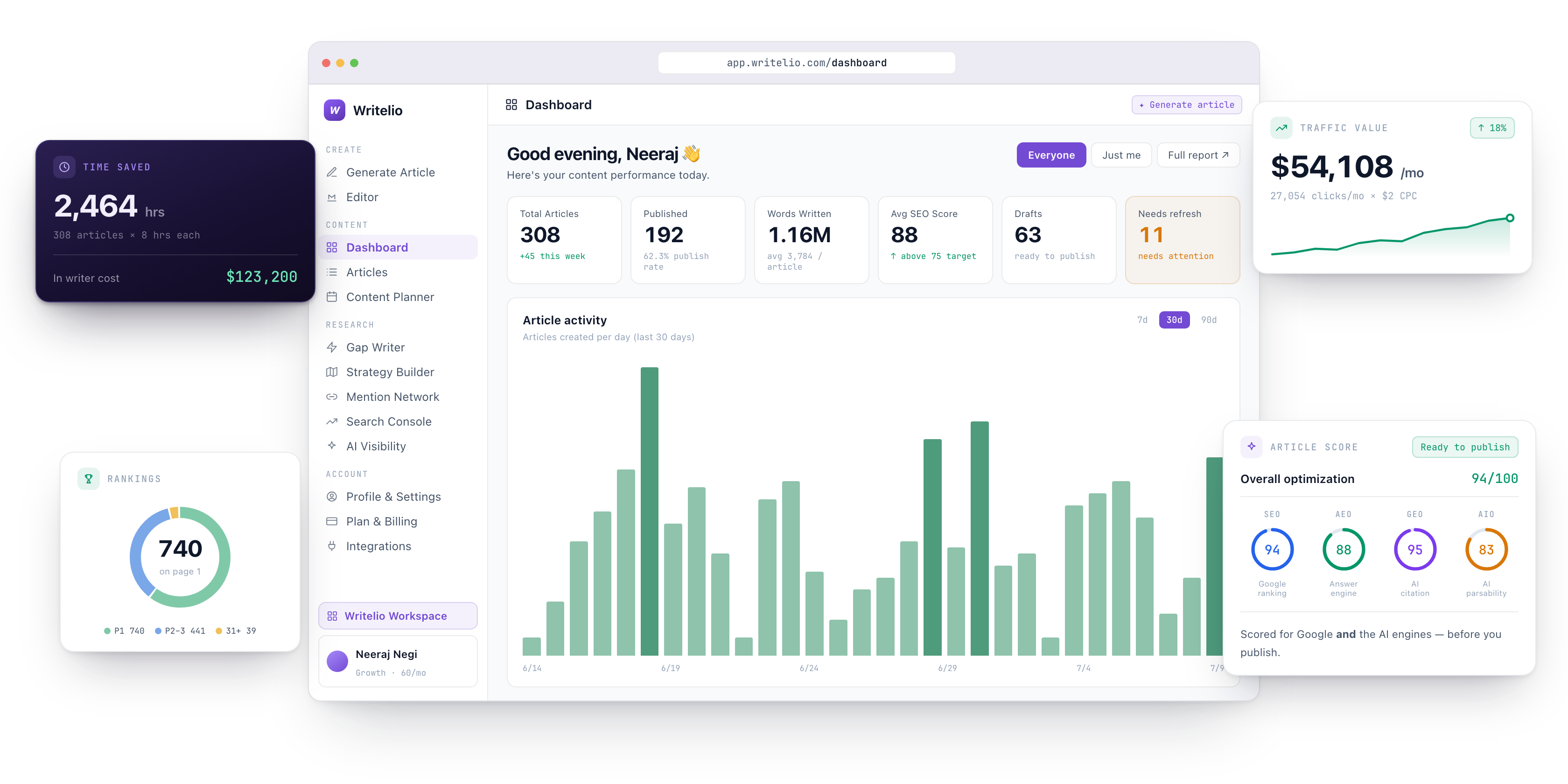
From one real Writelio workspace — 308 articles, 1.17M words, average SEO score 88. Time and cost saved are modelled at 8 hrs and $50/hr per article; traffic value is an Ahrefs estimate. The article count, word count and scores are measured.
And this is what it looks like on a client's site
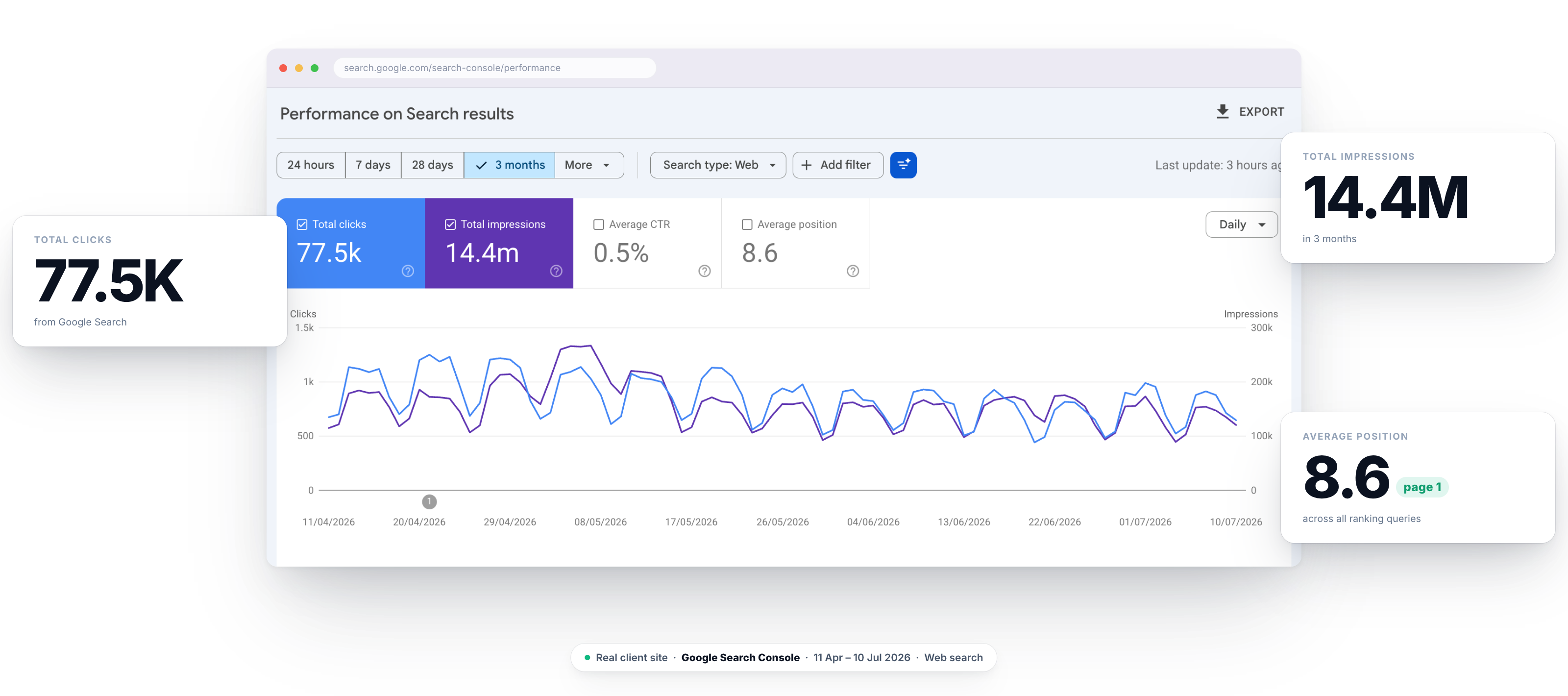
Straight from their Google Search Console — web search, 11 April to 10 July 2026. Published with the client's permission. We didn't redraw the chart, and we didn't hide the CTR.
Autopilot content is a liability, not a strategy.
Every other AI writer sells the same thing: publish while you sleep, without lifting a finger. Not one of them mentions who is accountable for what gets published.
The FTC has already brought enforcement actions over unsubstantiated marketing claims. “The AI wrote it” is not a defence. Ninety unreviewed articles a month is not leverage — it is ninety chances to publish a claim you cannot back up.
So Writelio does the opposite. AI does the work. You decide what ships.
Find it. Write it. Clear it. Publish it. Prove it.
Five steps. The third one is the one no other tool has.
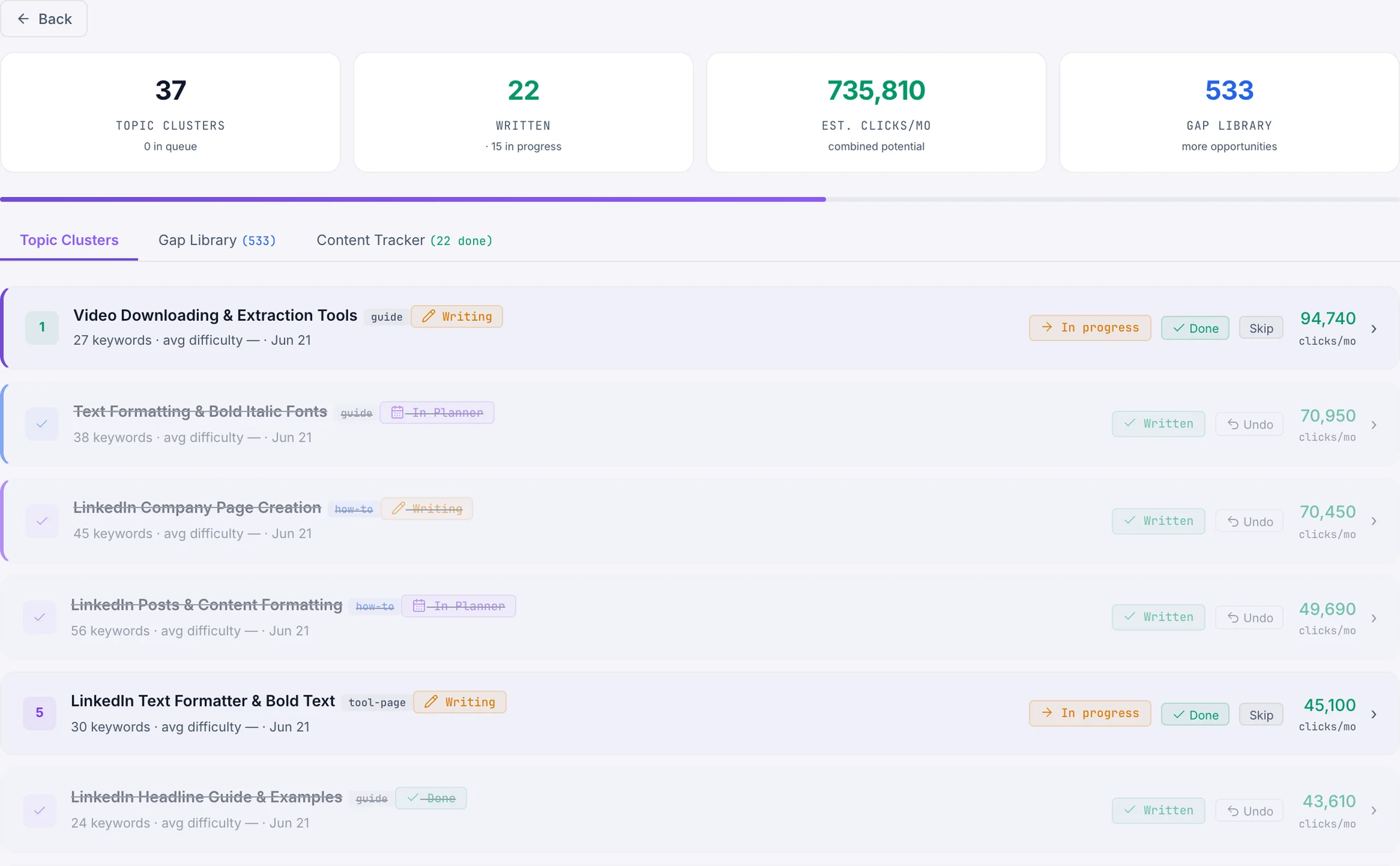
Gap Writer finds what competitors rank for that you don’t — real volume, real difficulty. 37 clusters, 735,810 clicks/mo of opportunity.
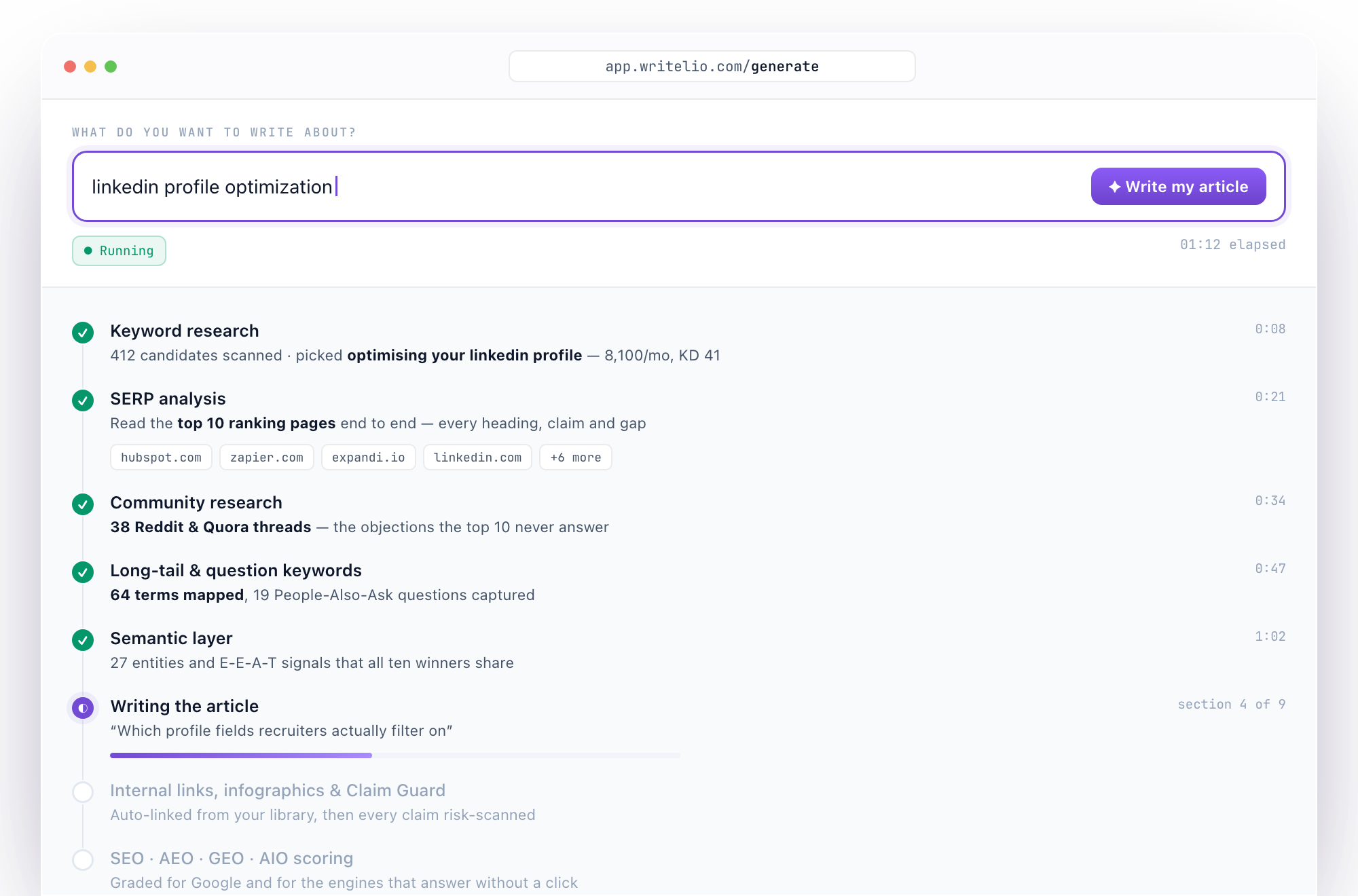
It reads Google, the SERP and real Reddit and Quora threads before writing a word — then drafts for SEO, AEO and GEO.
Claim Guard scans every sentence for unsupported claims and legal exposure — and rewrites the risky ones.
One click to WordPress, Webflow, Ghost, Shopify, Framer, Medium, Hashnode, HubSpot, Notion or any webhook.
Then we watch ChatGPT, Perplexity, Gemini and Google AI Overviews — and tell you the day they start citing you.

Most tools ask an LLM to write. We do the homework first.
Before a single word is written, Writelio reads the SERP, your competitors, and what real people are actually asking.
Give it a topic in plain English. Claude extracts a clean seed keyword — then pauses and shows it to you, so you can correct it before a cent is spent on research.
Paste the URL of the article that outranks you. Writelio scrapes it, pulls out the keywords it targets, the gaps it leaves and the angles it’s weak on — then writes the piece designed to beat it.
Real search volume and difficulty — scored against each other. Low-volume keywords are filtered out before we go further, unless the difficulty makes them winnable. You set the floor.
The live page-one results for that keyword, and every People Also Ask question — filtered down to the ones that genuinely matter.
Live Reddit and Quora threads, mined for the pain points people voice and the gaps every existing article leaves. This is why it sounds like it knows something.
Long-tail, question and related keywords pulled in parallel, merged and deduped — the strongest become your H2s.
The related concepts a page on this topic should contain — plus the content angles your competitors missed entirely.
All of it becomes a scored plan: each surface rated 0–100, an intro angle, the statistics to cite, E-E-A-T signals — and a word-count floor derived from intent, difficulty and community depth. Not a round number someone guessed.
One real run, before it wrote a single word
Strategy, outline, headline, final draft — you can approve each one, or let it run. That is the whole difference: the machine does the work, you keep the judgement.
People don’t only search on Google any more.
They ask ChatGPT. They read the AI Overview. They never click. An article written only for blue links is already losing three of the four places your buyer looks — so Writelio writes for all four, and scores each one 0–100 before you publish.
The classic game: the right keyword at the right difficulty, a structure that matches search intent, clean on-page signals and internal links.
Featured snippets, People Also Ask, voice results. The zero-click world — where being quoted matters more than being clicked.
Generative engines quote what they can verify. They favour specific claims, real statistics, clear attribution and genuine expertise — and ignore vague filler.
Google’s AI Overviews sit above every blue link. They summarise pages that are easy to parse — and skip the ones that aren’t.
No guessing whether it’s “good enough”. The editor grades every draft on each surface, live — so you fix the weak one before it goes out, not three months later.

AI writes it. Your lawyer doesn’t have to read it.
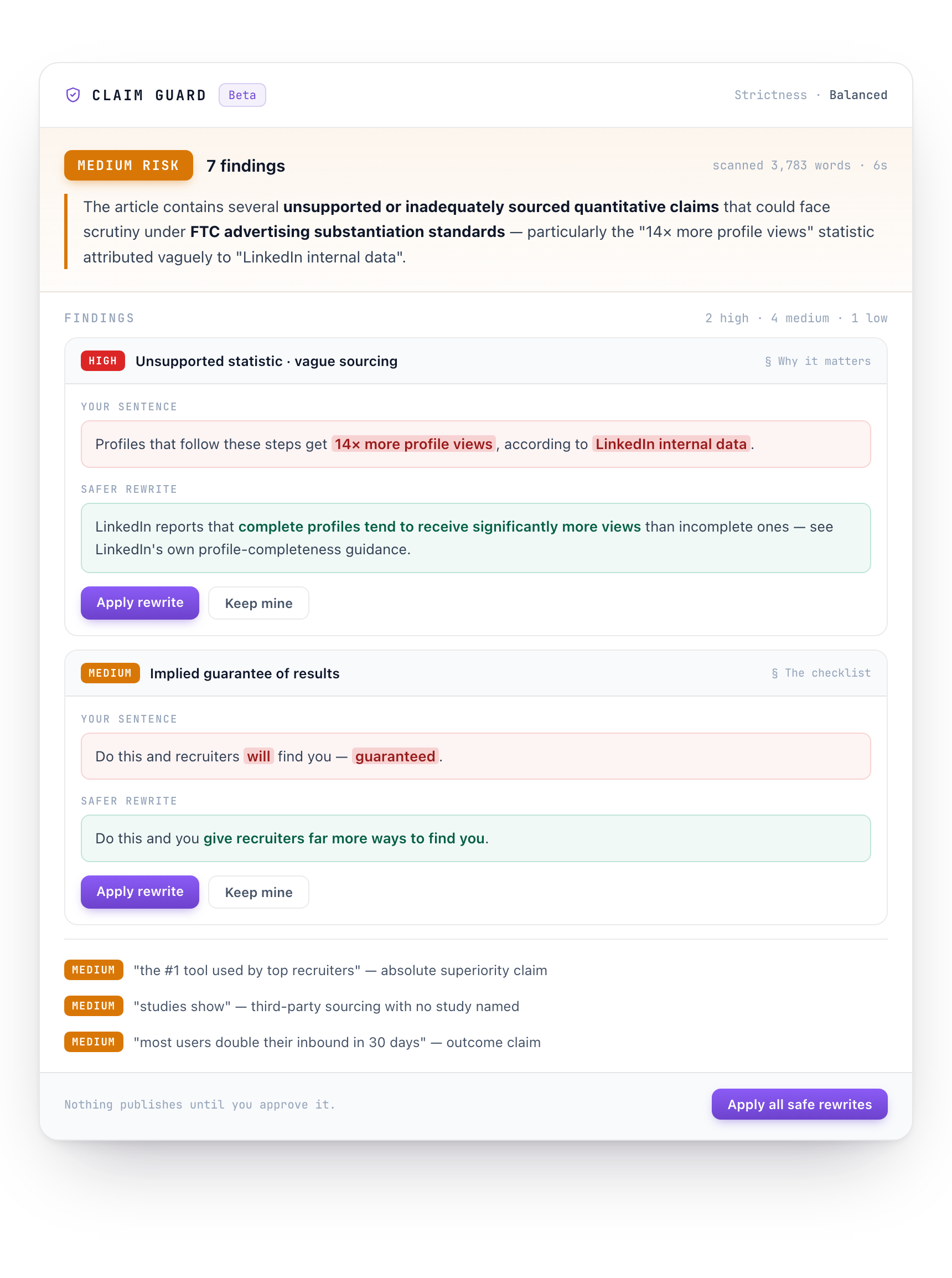
Before an article can publish, Claim Guard reads every sentence and flags the ones that could get you in trouble: unsupported statistics, absolute performance claims, implied guarantees, vague third-party sourcing.
It gives you an overall risk grade, an exact quote for each finding, and a safer rewrite. Then you decide.
We have not found another AI content tool that ships a claim-substantiation layer. If you find one, tell us.
AI engines only quote what they can verify.
A confident sentence with nothing behind it is worthless to ChatGPT — and dangerous to you. So Writelio treats sourcing as part of the writing, not an afterthought.
The strategy decides upfront which statistics the article should cite and which E-E-A-T signals it needs — before a sentence exists.
The Citations panel reads the finished draft back and shows you which claims carry a source — and which are floating free.
Claim Guard catches the “14× more views” statistic with a vague source. Fix it, or ship it knowing. Either way, you knew.
The AI Visibility tracker records your citation rate — how often an engine doesn’t just mention you, but links you as the source.
Four tools most teams buy separately.
You are not buying a writer. You are buying the whole content operation.
Finds every keyword your competitors rank for and you don’t — clustered into topics, scored by opportunity, one click to write.
Asks ChatGPT, Perplexity, Gemini and Google AI Overviews the prompts your buyers use — and records whether they name you.
Turns your site into a content strategy: pillars, buyer personas, a content moat — and a “never write this” list.
Editorial backlinks earned by relevance, not bought. Matched on topic, verified live — never a spammy swap.
Stop guessing what to write next.
Gap Writer takes your domain and your competitors’, and finds every keyword they rank for and you don’t — with real volume and difficulty behind each one.
Then it clusters them into topics, scores each cluster by opportunity, and pre-fills the pipeline. One cluster, one article, one click.
From one real analysis. That is a content calendar you didn’t have to invent.
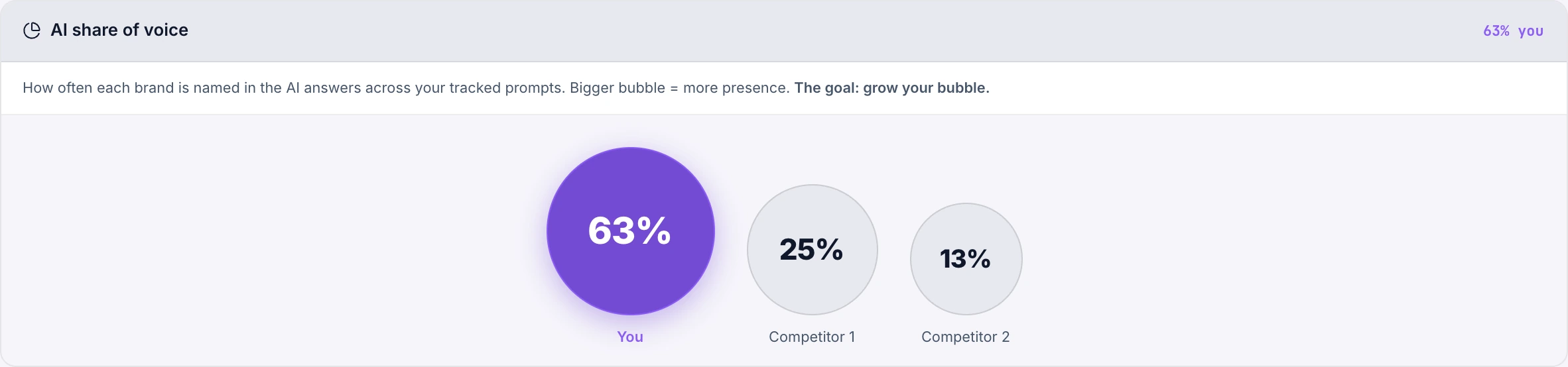
Trackers tell you AI ignores you. We fix it — and show you which article changed it.
Every AI-visibility tool on the market sells you a dashboard. They can all tell you that ChatGPT never mentions your brand. None of them can write the article that fixes it.
Writelio publishes and tracks. So when Perplexity starts citing you, we can point at the article that earned it.
Before the first article: what should you own?
Point it at your site. It reads what you sell and builds the content foundation the whole year runs on.
The handful of themes you should be known for — each one expandable into a full cluster of articles.
Who you are actually writing for, and what each of them is trying to decide.
The pieces only you could publish — the ones a competitor with the same AI tool cannot copy.
Just as valuable: the topics that will waste your money. Most tools will happily sell you those articles. We tell you not to.
Pick a pillar → it becomes cluster articles → straight into the Content Planner. You never stare at an empty calendar again.
Backlinks you could show a Google engineer.
Everyone else’s “exchange” is you link to me, I link to you. Google has recognised that pattern for fifteen years. Ours is built so it never appears.
Matching is asymmetric — A mentions B, B mentions C, C mentions A. No two sites ever point at each other. That is the whole point.
You set the floor. No links from sites you would be embarrassed to be seen with.
The mention is suggested while the article is being written, in context, on topic — because it belongs there, not because a script pasted it in.
Credits only settle once we have checked the published page and the link is actually there. No promises, no ghost links.
Approved. Then live, everywhere you write.
Ten platforms. Configure once — publish everywhere.
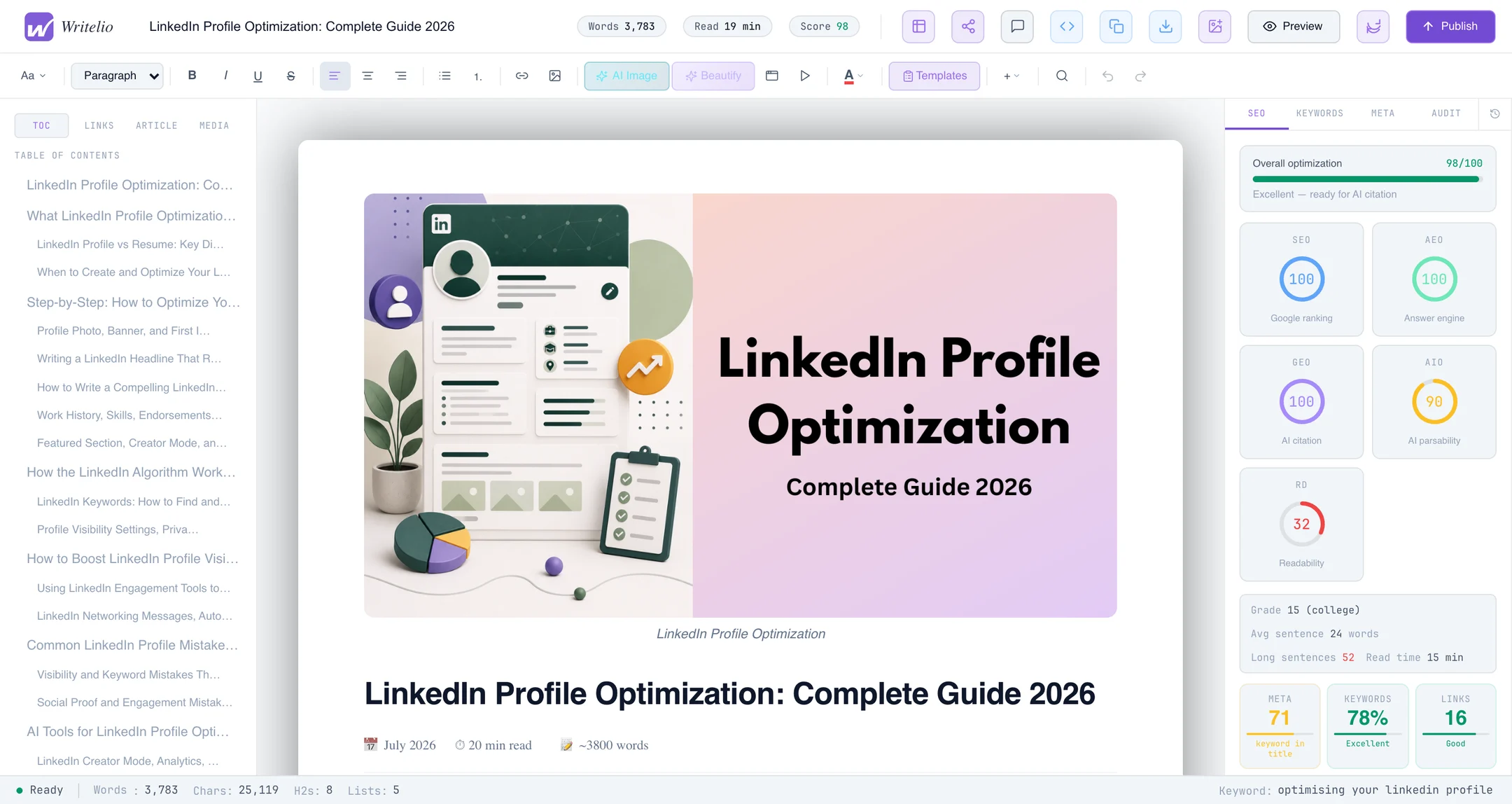
The editor scores every draft live — SEO, AEO, GEO and readability — while you edit.
AI writers ignore risk. Visibility trackers ignore publishing.
Writelio is built to do all three in one pass.
We didn't ask you to trust us. We built a whole site with it first.
Every performance number on this page comes from one real Writelio workspace — the one we used to build hyperclapper.com. 308 articles. 1,353 pages in its sitemap. It is live right now, and you can read every word of it before you give us a penny.
A freelance SEO writer charges $150–500 an article.
Writelio publishes from $2.21 an article. One mid-range freelance post costs more than a month of Growth.
2 seats
10 AI images / day
10 tracked AI prompts
3 seats
20 AI images / day
25 tracked AI prompts
5 seats
30 AI images / day
50 tracked AI prompts
Priority support
10 seats
50 AI images / day
100 tracked AI prompts
API access · white-label
Every plan includes the full product — Claim Guard, Gap Writer, AI Visibility, the editor and publishing to all 10 destinations. Start with a 7-day free trial, no card required. If you subscribe and it isn't for you, email us within 7 days of your first charge and we'll refund it. Cancel anytime, from your account, in two clicks.
Straight answers.
Will AI content get penalised by Google?
Who is liable for claims an AI wrote?
Do I have to publish on autopilot?
What are AEO, GEO and AIO — and why should I care?
How do you know an AI engine actually cited me?
Does it just make up statistics?
Can it sound like us, not like a robot?
Where can I publish it?
Is there a free trial? Do I need a card?
What happens to my articles if I cancel?
How long does one article take?
Can I use my own brand voice and authors?
Can my team work in this together?
Do you write in other languages?
What if the keyword it picks is wrong?
Is my content used to train anyone’s model?
Can I import articles I already published?
What happens when I hit my article limit?
Do ChatGPT and Perplexity actually cite you?
AI Visibility asks the engines the questions your buyers ask, records who gets named, and then writes the article that changes the answer. Not a dashboard that tells you you're invisible — the thing that fixes it.
See AI Visibility →Ship content you'd sign your name to.
It reads the SERP before it writes a word — then claim-checks every line and waits for your approval.